MamoriFull kit

Mamori conceptFull kitJapan certification

4 · Japan

Japan certification

Radio, telecom terminal, electrical safety and EMC for a small home device in Japan. To be confirmed with a certification body.

Concept, to be validated in the prototype. Nothing here is tested.

Certification notes

What a small home device with Wi-Fi, Bluetooth LE and a cellular link, sold in Japan, would need to look at. The entries below come from the research files, official sources first. Everything here is to be confirmed with a certification body; medical-device questions are to be confirmed with a regulatory specialist and the authority.

What the work starts from (design intent)

  • Radios: Wi-Fi and maybe Bluetooth LE through a pre-certified module, and an LTE-M or LTE Cat-1 cellular module with Japan bands, each used unchanged with its intended antenna.
  • Cellular: the device connects to a mobile network, so terminal-equipment conformity and any network operator’s own device approval are on the list.
  • Power: USB-C wall adapter (in the box or not: to decide); battery backup: to decide.
  • Possible-fall flag: a design target, not validated. Mamori is not intended to be a medical device and makes no claim about any illness. Whether a fall feature changes that is to be confirmed with a regulatory specialist and the authority.
  • No camera.

Topics the research covers

  • Radio Act technical conformity (Giteki) for Wi-Fi / Bluetooth LE and for LTE.
  • Telecommunications Business Act terminal equipment conformity for the cellular part.
  • Network operator device approval, if the chosen operator requires it.
  • Electrical Appliance and Material Safety Act (PSE) for the adapter, and for a battery if one is added.
  • VCCI (voluntary EMC scheme).
  • Medical-device rules and a fall feature.
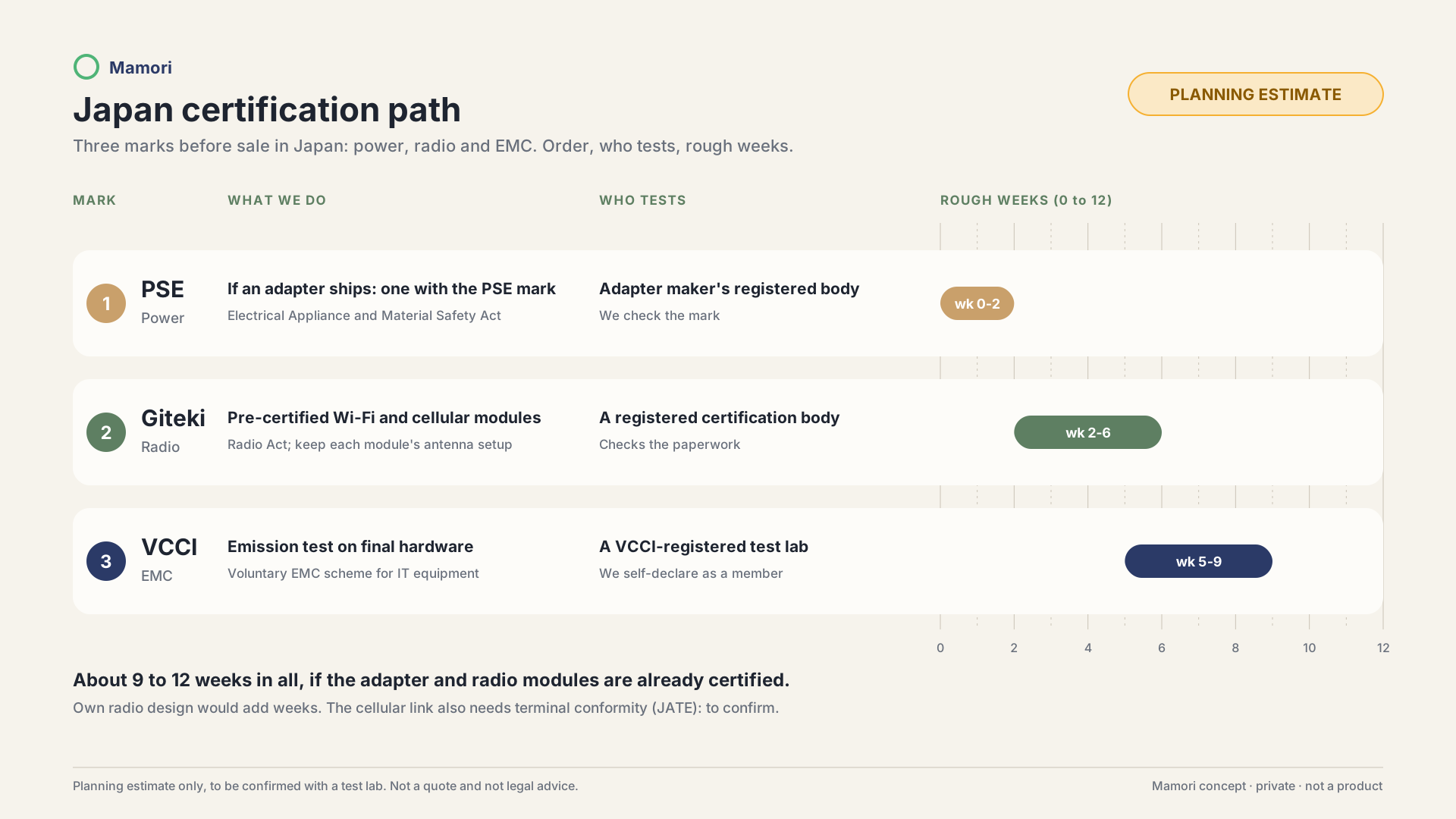
Japan certification path: PSE for the adapter, Giteki for the radio modules, VCCI for EMC, with rough weeks
Certification path, a planning estimate drawn for this kit; it is not from the research files and is to be confirmed with a certification body and a test lab. The cellular terminal conformity and any operator approval come on top. Open full size.

Findings

Radio Act technical conformity (Giteki) for the Wi-Fi and LTE modules

Covers
Wireless equipment must hold a Radio Act (denpaho) technical conformity certification (tekigitsu goutei shomei) or a construction design authorization (koutei sekkei nintei) and carry the Giteki (R) mark before it may be used in Japan without a station license. Using a module already certified in Japan, unchanged, is the standard route.
Applies to this device
yes — both the pre-certified ESP32-S3 Wi-Fi module and the LTE-M/Cat-1 cellular module are Radio Act equipment; the device inherits the module's certification only if the module is used as certified (no changes to the RF parts), and the Giteki mark must be displayed on the product.
Notes
JATE is one of the registered certification bodies performing these Radio Act tests and reviews. If the final enclosure or antenna changes RF performance vs. the certified module, a new certification or an engineering review of the end product can be required — confirm with the module maker.
Sources

To be confirmed with a certification body.

Telecommunications Business Act terminal equipment conformity (T nintei) for the cellular part

Covers
A terminal that connects to a telecommunications carrier's network must be conformity-certified (or have its design authorized) by a registered certification body (touroki nintei kikan) so the carrier's network is protected; the carrier then performs no per-user connection inspection.
Applies to this device
yes — the LTE-M/Cat-1 module connected to a Japanese carrier's network is terminal equipment under the Act; certification is done per-design by registered bodies (JATE is one). The pre-certified module route applies only if the module's design is used unchanged and the carrier accepts it.
Notes
JATE's own page states that IoT terminals commonly need both the Radio Act certification and the Telecommunications Business Act certification. The MIC lists the registered bodies in its terminal equipment certification guide (soumu.go.jp; the page was not reachable when checked).
Sources
  • JATE: technical conformity certification and design authorization for telecommunications terminal equipmentQuote: 有線・無線接続に関わらず、端末機器の情報が電気通信事業者(NTT東西等)のネットワークを通じて伝送される場合には、通信事業者の回線設備・機能を保護するため、「電気通信事業法に基づく技術基準適合認定等 (T認証)」を受けなければ、使用することができません。
  • JATE: note on IoT terminal equipmentQuote: いわゆるIoT端末機器は、「電波法に基づく技術基準適合証明」が必要であるのはもちろんのこと、「電気通信事業法に基づく技術基準適合認定」が必要となる場合も、数多くあります。

To be confirmed with a certification body.

Network operator / MVNO device approval (carrier-side acceptance)

Covers
Before an IoT device can be provisioned on a Japanese carrier's network, the carrier runs its own device/module acceptance: it must interoperate with the carrier's core network (APN, protocol, firmware update) and, for the cellular part, hold the certifications in entries 1-2. Carriers publish the modules they accept.
Applies to this device
likely — the LTE-M/Cat-1 module with a nano-SIM must be on (or accepted into) the chosen carrier's list of approved communication modules; SoftBank, for example, maintains a public list of modules that have completed interconnection testing with its network, including Cat.M1/NB-IoT modules.
Notes
SoftBank's public module page lists approved 5G/4G/LPWA modules and states modules are ones that have completed interconnection testing (joshuusei shiken) with the SoftBank network. Docomo and KDDI keep equivalent programs; their public IoT pages were not reachable when checked, so the carrier-specific pages should be confirmed when the target carrier is fixed.
Sources

To be confirmed with a certification body.

PSE (Electrical Appliance and Material Safety Act) for the AC adapter, and for a lithium battery if one is added

Covers
Products connected to the mains must carry the PSE mark. There are two PSE categories: a diamond PSE for specified electrical appliances (kijun denki youhin, subject to a full safety certification) and a circle PSE for other denki youhin (subject to self-declaration). A lithium battery inside the device is also a denki youhin and triggers PSE.
Applies to this device
to confirm — the USB-C wall adapter (AC-to-DC) is a specified electrical appliance and requires a diamond PSE (certification via a registered certification body); the device itself, if it contains a lithium battery, requires PSE for the battery. If the device is powered solely by the adapter with no internal battery, the device may not be a PSE subject product, but the adapter is. The METI PSE page (meti.go.jp/policy/consumer/seian/denkai/) was not reachable when checked; confirm the exact category and whether the chosen adapter already holds a valid PSE certificate before shipping.
Notes
METI is the competent authority. The adapter must already have a PSE certificate from a registered certification body; using an off-the-shelf PSE-certified adapter avoids a separate PSE process for the adapter itself. Official source pending: the METI PSE pages could not be read when checked; to be confirmed with a certification body.
Sources
Official source pending; to be confirmed with a certification body

VCCI (voluntary EMC conformity for multimedia equipment)

Covers
VCCI is Japan's voluntary EMC self-regulation scheme for multimedia equipment (MME) sold into Japan. Members test their product against VCCI Class A or Class B emission limits at a VCCI-registered measurement facility, file a conformity notification (tekikou kakunin todokede) before shipment, display the VCCI mark, and are subject to market sampling tests.
Applies to this device
likely — a consumer home device with a speaker, microphones and Wi-Fi is an MME (information technology equipment). If sold in a residential context it is Class B. It is voluntary, but most Japanese retail and OEM channels expect the VCCI mark; a device without it may face buyer pushback. Note: VCCI explicitly excludes products whose primary function is wireless transmission/reception under the Radio Act — a device whose main function is cellular communication may be outside VCCI scope; confirm the classification with the device's primary function.
Notes
VCCI membership is required to use the mark. The conformity notification takes roughly one week from filing to acceptance notice. Class B is the residential class and is the right target for a home device.
Sources

To be confirmed with a certification body.

Medical device question (PMDA / MHLW): when software or a device becomes a medical device in Japan

Covers
Under the Pharmaceuticals and Medical Devices Act (Iyakuhin Iryoukiki Touhou, 2014), a product (or a standalone software / SaMD) is a medical device when it has a medical purpose (a purpose about disease or injury, as the law defines it) and, if it fails to work as intended, could affect a patient's or user's life or health. PMDA reviews higher-risk devices; MHLW runs the conformity-consultation and case-database for whether a program is a medical device.
Applies to this device
to confirm — the 'possible-fall flag' is a design target and not a medical claim. If the device is marketed only as a safety convenience for the home (e.g. 'alerts a caregiver if movement stops' without any medical language), it is most likely NOT a medical device. The risk flips if any marketing, UI text or support script frames the flag as a medical function (about an injury or a health condition) or as a replacement for a medical judgement — that would make it SaMD / a medical device and trigger PMDA approval (Class I general, Class II/III registration or approval depending on risk). Wording about falls specifically is the known grey zone: MHLW's published case database and PMDA's 'review key points' for home-use program medical devices that 'detect signs of disease and prompt a visit' (Jiyou Programmed Medical Device that detects early signs and prompts a doctor's visit) are the two documents to read before fixing the product copy.
Notes
PMDA's own page on program medical devices (SaMD) defines the regulated class and points to MHLW's case database. MHLW's page on the medical-device-program conformity consultation (Samdo Gaitousei Sodan) is the official route to get a written answer on whether a specific software function is a medical device. Get that answer in writing before launch; it is the cheapest way to close this risk.
Sources
  • PMDA: Program medical devices (SaMD) — what makes software a medical deviceQuote: 医薬品医療機器等法において、規制対象となるプログラム医療機器は、医療機器としての目的性を有しており、かつ、意図したとおりに機能しない場合に患者(又は使用者)の生命及び健康に影響を与えるおそれがあるプログラム(ソフトウェア機能)(人の生命及び健康に影響を与えるおそれがほとんどないもの(一般医療機器に相当するもの)を除く。)とされています。
  • PMDA: review key points for home-use program medical devices that detect early signs and prompt a visitQuote: 疾病の兆候を検出し受診を促す家庭用プログラム医療機器
  • MHLW: On medical device programs (SaMD conformity consultation and case database)Quote: 医薬品医療機器等法に基づき規制される医療機器プログラムは、医療機器としての目的性を有しており、かつ、意図したとおりに機能しない場合に患者(又は使用者)の生命及び健康に影響を与えるおそれがあるプログラム(ソフトウェア機能)(人の生命及び健康に影響を与えるおそれがほとんどないもの(一般医療機器に相当するもの)を除く。)であり、その基本的な考え方等は、「プログラムの医療機器該当性に関するガイドラインについて」(令和3年3月31日付け薬生機審発0331第1号・薬生監麻発0331第15号)において示しています。

To be confirmed with a certification body.

Some medical-boundary wording is summarised on this page; the research file has the full text.